
For parents and young golfers, one of the hardest questions isn’t how much a student trains, but whether that training is actually working. In golf, this can be tricky. Raw scores alone rarely tell the full story. They are influenced by weather conditions, course difficulty, length, and even pin positions.
A score of 72 on one course may be very different from a 72 on another. This is why absolute scores are often a poor measure of true progress. To make comparisons more meaningful, golf courses have ratings and indexes that reflect relative difficulty. These adjustments help provide context for scores.
At IJGA, we want to understand how our students’ progress compares with that of other junior golfers. With our high-quality training facilities, coaching team, fitness instruction, and structured training programs, we expect our students to progress at a higher rate than those without these opportunities.
There’s no single perfect way to measure junior golf development. At IJGA, we use multiple methods to track student progress, each serving a different purpose.
Using Tournament Results to Evaluate Performance
Competing in tournaments is the ultimate test of a player’s development. It reveals how well their skills withstand pressure, the quality of their decision-making in a competitive environment, and their ability to execute consistently across a variety of courses and conditions.
Best For: test environment under pressure, data of strengths and areas that need improvement, scores for handicaps, scoring averages, junior databases, building experience, and motivation.
Limitations: scores vary due to weather and course conditions; placement in the tournament depends on the strength of the field; it can be a one-off performance, either good or bad.
Interpretation: often the main focus for parents, which again can be good or bad, but mainly useful for short-term feedback rather than long-term assessment.
Tracking Progress Through Adjusted Scoring Averages
Raw scores alone don’t always tell the full story. Adjusted scoring averages help account for course difficulty, field strength, and playing conditions, giving a more accurate picture of how a player is progressing relative to competitive standards.
Best For: tracking improvement over a short period of time, providing focus to students on the importance of disciplined attention to scoring in tournaments.
Limitations: must adjust for rating, but cannot objectively adjust for weather or course conditions, need to exclude outlier good or bad results to gain a representative average.
Interpretation: easiest high-level monitor of progress, helpful as a personal benchmark, and the most practical metric for short-term monitoring of performance.
How Coaches Evaluate Technical Development
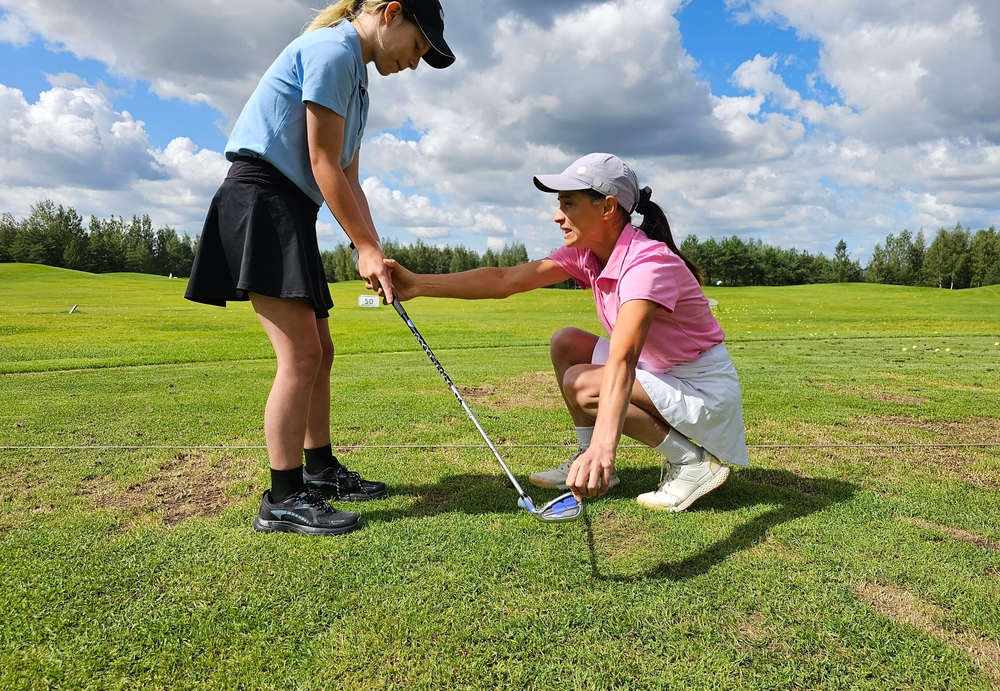
While performance data shows the results, the coaching evaluation explains how those results are achieved. Coaches gain insight into the training process by observing changes in technical skills, decision-making, practice routines, and competitive mindset.
Best For: technical development, identifying specific strengths and weaknesses to plan a training program over a period of weeks.
Limitations: subjective, detailed, and cannot readily be used to compare across students.
Interpretation: essential for individualized training, but not a broad measure of overall progress, mainly suited to short-term and medium-term development.
What the Data Shows
While these methods remain valuable for internal feedback and technical improvement, they don’t provide a fully objective benchmark. To compare students with the wider junior golf population over the course of a year, we prioritize Junior Golf Scoreboard (JGS) percentile movement as the key reference point for parents.
JGS collects scores from almost all major junior golf events in the USA and many international events, adjusts them for course rating and playability, and calculates average scoring differentials over twelve months.
Students are then ranked within their graduating class, allowing consistent comparison across players. Because JGS is based on a rolling twelve-month data window, it’s designed to reflect long-term development trends and isn’t intended as a short-term evaluation tool. In the short term, we prefer to look at adjusted scoring averages.
Fall 2025 Junior Development Results
In the Fall 2025 semester, 80% of IJGA students improved their graduating class percentile ranking. In cases where rankings didn’t improve, this was mostly due to injuries limiting participation in tournaments.
Average improvements by percentile group:
| Average | Max | Min | |
|---|---|---|---|
| Top 10% | 3.2% | 20.7% | -1.7% |
| 10%-30% | 4.4% | 15.2% | -2.5% |
| 30%-50% | 9.9% | 30.2% | -0.4% |
| 50%-100% | 6.5% | 15.2% | -1.1% |
Eighteen-Month Junior Golf Progress Data
For students who remained at IJGA for the full eighteen-month period, the improvements were even stronger:
| Average | Max | Min | |
|---|---|---|---|
| Top 10% | 4.4% | 11.3% | -1.7% |
| 10%-30% | 10.5% | 40.3% | -7.1% |
| 30%-50% | 15.1% | 30.4% | 1.9% |
| 50%-100% | 10.0% | 26.5% | -5.7% |
Observations: mid-ranked players are most likely to show the strongest gains, as it is easier to improve by many shots when scoring in the high 70’s rather than when scoring below par.
What Is the Best Metric for Long-Term Junior Golf Progress?
A single metric cannot capture progress in junior golf. Tournament wins, scoring averages, and coach evaluations all provide valuable information for specific purposes, but they each have limitations. For parents who want an objective view of a student’s development relative to peers, JGS percentile movement is the most reliable metric.
Frequently Asked Questions About Measuring Junior Golf Development
The most reliable method combines multiple indicators, including tournament performance, adjusted scoring averages, and professional coaching evaluations. Tracking progress relative to other competitive junior players provides the clearest long-term benchmark.
Adjusted scoring averages account for course difficulty and competition level. This makes them more accurate than raw scores when measuring performance over time.
Most academies, such as IJGA, track tournament results, scoring trends, technical skill development, and progression in competitive rankings. Monitoring change over time shows whether improvement is consistent and meaningful.
Coaches evaluate technical changes, decision-making, practice habits, and competitive performance. Their assessments help explain why results are improving or where development is needed.
Progress varies by player, but consistent structured training typically produces measurable changes over several months. Long-term development is best evaluated across multiple seasons.
Comparing performance to the wider junior golf population shows whether a player is advancing competitively, not just improving individually. Relative progression is essential for college recruitment and higher-level competition.
Yes! Documented performance trends, competitive results, and ranking progression help college coaches evaluate readiness and potential.
Parents should look for steady improvement over time, consistency across competitions, and alignment between performance results and coaching evaluations.
Start Measuring Real Progress at IJGA
At IJGA, we use multiple performance measures to guide coaching and training, while focusing parents on the metric that provides the clearest long-term benchmark of progress. By tracking objective percentile movement relative to the broader junior golf population, families gain a transparent view of development over time.
These results show that structured training, disciplined effort, and professional coaching create consistent improvement. Students who train within an integrated system are positioned to compete more effectively, build stronger competitive profiles, and pursue collegiate opportunities with credibility.
Ready to understand how a structured development model works in practice? Start by exploring our Admissions Guide to see how we develop players from promising juniors into global competitors. Even better, plan your visit and experience firsthand what makes our academy the choice for aspiring champions around the world!